Water conservation for time
AGRASEN
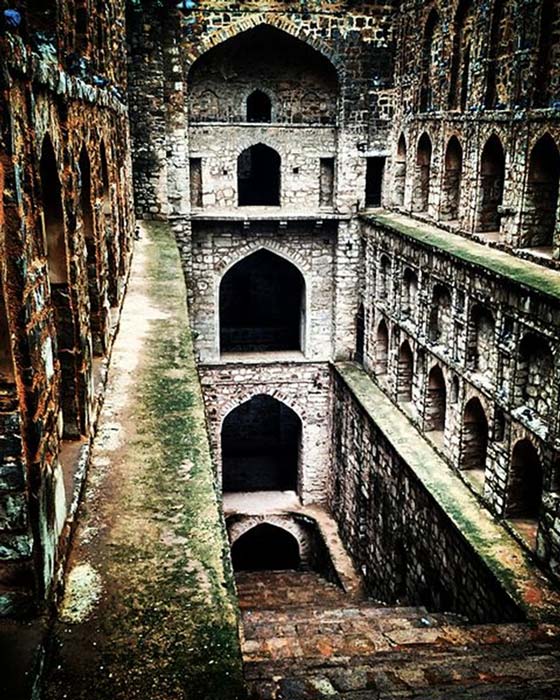
KI BAOLI in
Delhi is a stepwell built on four levels. It was probably built in the 14th century
by wealthy merchants, in the name of Raja Agrasen, the grandfather of
Krishna and Balram.
108 steps lead
downwards to the water level. The first two levels have niches in the walls
that must have served as meeting places, and there are passages and rooms
inside the baoli. In the northern end of the baoli is a well. In the past,
as the water rose in the well, it would fill the baoli from the bottom
to the top level. The
steps were built next to the shafts of wells so that whatever the level of the
groundwater, residents could always access some.


It seems likely that there was a stepwell
here many centuries ago, we know for example, that the Bronze Age Indus Valley
Civilization built these water-harvesting structures.
But this isn't the only
Baoli in Delhi, or the most famous.
The HAZRAT NIZAMMUDIN BAOLI is situated at
current day Hazrat Nizam-ud-din basti.
Legend has it that while Khwaja Nizam-ud-din Auliya was building
this in 1321-22, the
ruler, Ghiyas-ud-din Tughlaq was trying to build Tughlakabad. He forbade
the workers from working on the baoli, so they would help the sufi saint at
night. To light their way, Chiraguddin Auliya, a disciple of the Khwaja's,
lit lamps with water instead of oil. The water here is also
believed to have healing powers. And the Khwaja cursed Tughlaqabad to be a
ruin.
However, when Ghiyas-ud-din Tughlaq realised the issue of water scarcity which resulted from the curse of Nizammudin Chishti, he planned 13 well-dug baolis in TUGHLAQABAD Fort. However, only two baolis can be identified in the fort premises today:
RED FORT BAOLI - A rare L shaped baoli, this baoli is believed to be older than
Red Fort itself and has been constructed with uniform sized stones.
FEROZ SHAH KOTLA BAOLI - the only circular
one in Delhi, and also the largest in terms of area, this 14th century baoli
was built within Feroz Shah Kotla by Feroz Shah Tughlaq as he tried using the
construction of structures to save the people from a collapsing economy.
LOHARHERI
BAOLI - Discovered very recently, this baoli in
Dwarka was covered with dense vegetation. It could have belonged to
ironsmiths, therefore the name. It is the smallest baoli in
Delhi with just 20 steps to the tank.
RAJON KI BAOLI - This well-kept baoli
that was built in 1516 in Mehrauli reflects the time when
it was built, i.e. during the reign of the Lodis. This baoli is four storeys deep and
attached to a mosque. The walls of the baoli also
adorn calligraphic inscriptions from the Quran. It is also the largest and the
most ornate of the three baolis in
the complex.
MUNIRKA BAOLI - Built in 1526
( odd to think of the 16th century as rather recent but there it is), this stands between a gurudwara and a temple. Known for
its design, it is surrounded by well-manicured lawns now. Interestingly, the baoli also has another well within
the complex. This baoli makes
for an interesting visit as it is exemplified Lodi-style architecture.
OLD RIDGE BAOLI - Built in 1354 this baoli is situated
within the Hindu Rao hospital complex and close to the main hospital building.
It was the only source of water during the 1857 war of independence.
PURANA QILA BAOLI - Built in: 1538 and situated in the Old Fort complex,
this baoli had 89 steps
to reach the water level and is fully functional!
ARAB
SARAI KI BAOLI - Built in the 16th century by Akbar, this is the second
smallest baoli in Delhi
and located in the Humayun's Tomb complex so is a Unesco World
Heritage Complex and the architecture is unique.
But this is just one of the many systems of water conservation that India employed over the centuries. Our
traditional systems in water harvesting and storage included capturing rain
water and reducing evaporation losses by planting trees on the periphery or by
building a wall across a stream to retain water in the dry season.
There were traditional techniques of water conservation used across India that have lasted for centuries. Just one example from each corner of India is given below -
Johads and Naadis in Rajasthan - A johad/ pokhar or a percolation pond[1], is a community-owned traditional harvested rainwater storage wetland principally used for effectively harnessing water resources in the states of Haryana, Rajasthan, Punjab, and western Uttar Pradesh of North India, that collects and stores water throughout the year, to be used for the purpose of recharging the groundwater in the nearby water wells, washing, bathing and drinking by humans and cattle. Some johads also have bricked or stones masonry and cemented ghats
 |
| Johad at Rithal village of Rohtak district of Haryana |
Eris tanks in Tamil Nadu - cascading tanks built several hundred years ago to utilize the water flowing in the rivers to the fullest before it reached the sea. It was a simple act of engineering that involved diversion of river water into tanks through dug out earthen channels and then diversion into a series of cascading tanks so that the outflow from one tank would serve as the inflow for the next one.
Surangam tunnels in Karnataka and Kerala - Suranga (also Surangam or thurangam) (English: Tunnel well) is a traditional water management system used to provide a reliable supply of water for human settlements and irrigation in Kasargod district of Kerala and Dakshin Kannada district of Karnataka, India.[1][2][3] A suranga is basically a horizontal tunnel dug in the slope of a laterite hill for about 30 metres (98 ft) to 40 metres (130 ft), which uses gravitational force for extraction of the underground water and collect into a storage tank.[2] As both the areas are covered by uneven and steep laterite hill which makes boring of traditional bore well hard and expensive, surangas are considered as a relatively cheap option.
All these are
managed by local
community members, and use minimum or no fossil fuel-based energy.
They maximized the availability of water by minimizing the loss of water by
combining natural and man-made waterways
and architecture in an aesthetic and functional way.
Even
today, most of these techniques form the basis of our current day water
conservation efforts, like rainwater harvesting, groundwater
recharge, drip-irrigation, and
revitalizing freshwater bodies in cities,
towns and villages.


Comments
Post a Comment